

Shoulder Replacement Surgery
Medically reviewed by Christopher M. Brusalis, MD ; Michael C. Fu, MD, MHS
Summary: Total shoulder replacement surgery is a highly successful procedure to reduce pain and restore mobility and function in people with end-stage shoulder conditions, including shoulder arthritis, certain rotator cuff tears or, sometimes, after a severe shoulder fracture. There are two general types of total shoulder replacement surgery: Anatomic total shoulder replacement and reverse total shoulder replacement. This article focuses on the former.

See our reverse shoulder replacement page to learn more about that procedure.
On this page:
- What is shoulder replacement surgery?
- What conditions can it treat?
- How do I know if I need surgery?
- Who should not get it?
- Can any treatments delay a shoulder replacement?
- What are possible surgical alternatives?
- What happens during surgery?
- How long does the implant last?
- Types of replacement implants
- What are the risks?
- Can you go home right after surgery?
- What is the shoulder recovery time?
- Are there any permanent restrictions?
- Is the surgery worth it?
- Why should I come to HSS?
- Key takeaways
What is shoulder replacement surgery?
Total shoulder replacement, also known as total shoulder arthroplasty, is the replacement of portions of the shoulder joint with artificial implants to reduce pain and restore range of rotation. It is very successful for treating the severe pain and stiffness caused by end-stage arthritis and for other conditions, including severe shoulder fracture, nonunions resulting from a prior fracture, and avascular necrosis.
The primary joint of the shoulder, called the glenohumeral joint, is a ball-and-socket joint in which the humeral head (at the top of the humerus, or the upper arm bone) forms the ball and the glenoid cavity (at outer edge of the scapula, or shoulder blade.) forms the socket. The ball and socket are covered with smooth cartilage to facilitate gliding motion.
In arthritis of the shoulder, this smooth cartilage degenerates, causing the bone surfaces to come into direct contact. This increases friction, which then damages and roughens the bone, causing stiffness and pain. Surgically implanted artificial replacement surfaces restore pain-free movement, strength and function.
What conditions are treated by shoulder replacement surgery?
Although it can be used to treat a number of shoulder conditions, the most common reason for a patient to undergo a shoulder replacement is to treat shoulder arthritis. There are two basic types of arthritis that affect the shoulder: osteoarthritis and inflammatory arthritis.
- Osteoarthritis (OA) is physical wear and tear on the cartilage inside the joint that develops from years of use or previous trauma. Although many older adults experience OA at some point, they are more likely to get it in their knees, hips or fingers than the shoulder. OA in the shoulder is more common in exceptionally active people (even at younger ages), such as tennis players, weightlifters and other athletes who put continual pressure on their shoulders. In some cases, a severe, acute injury triggers or contributes to this long-term damage, for example, a past torn rotator cuff or shoulder fracture. This is known as post-traumatic osteoarthritis.
- Inflammatory arthritis is an umbrella term for several chronic, autoimmune diseases which have no completely understood cause, such as rheumatoid arthritis. Many people with these conditions who have replacement surgeries experience reduced pain and improved function in the shoulder.
How do I know if I need a shoulder replacement?
The most common reason for a person to have this surgery is when they have shoulder pain from arthritis that can't be controlled with nonsurgical treatments. The pain is usually accompanied by progressive stiffness and a grinding or grating sensation in the shoulder.
This indicates that bones that form the ball and socket of the shoulder joint are rubbing against one another because the cartilage that should lie between them has worn away.
Diagnostic testing for replacement candidates
To diagnose arthritis in the shoulder, a doctor will order a series of standard X-rays. A CT scan may also be necessary to evaluate a patient's bony anatomy for presurgical planning, and magnetic resonance imaging (MRI) may be ordered to determine the condition of important surrounding soft tissues, such as the rotator cuff tendons.
 X-ray showing osteoarthritis of the shoulder joint. Bones of the joint are in direct contact rather than being lined with healthy cartilage.
Who is not a candidate for shoulder replacement?
Certain patients are not good candidates for shoulder replacement. These include those who:
- have symptoms that are not significantly disabling
- experience loss or paralysis of both rotator cuff and deltoid muscles
- have active infections
- have a progressive disease of the nervous system that has affected the joint (assessed on a case-by-case basis)
Can any treatments delay the need for shoulder replacement?
Some patients who are experiencing early stage osteoarthritis may wish to first try nonsurgical, conservative management of their condition to determine whether a shoulder replacement is necessary or may be delayed. Such measures include:
- physical therapy.
- NSAIDs (nonsteroidal anti-inflammatory drugs)
- corticosteroid injections and/or other interventional treatments
What are possible surgical alternatives to shoulder replacement?
A shoulder arthroscopy procedure is sometimes recommended for patients who have shoulder conditions that involve the surrounding ligaments, muscles and tendons, such as a rotator cuff injury or biceps tendon conditions. Arthroscopy is among the most common type of shoulder surgeries, and is attractive to many patients because it is minimally invasive. However, arthroscopic surgery cannot regenerate the cartilage or reverse arthritis. This treatment is generally useful in patients who do not yet have bone-on-bone arthritis.
What happens during anatomic shoulder replacement surgery?
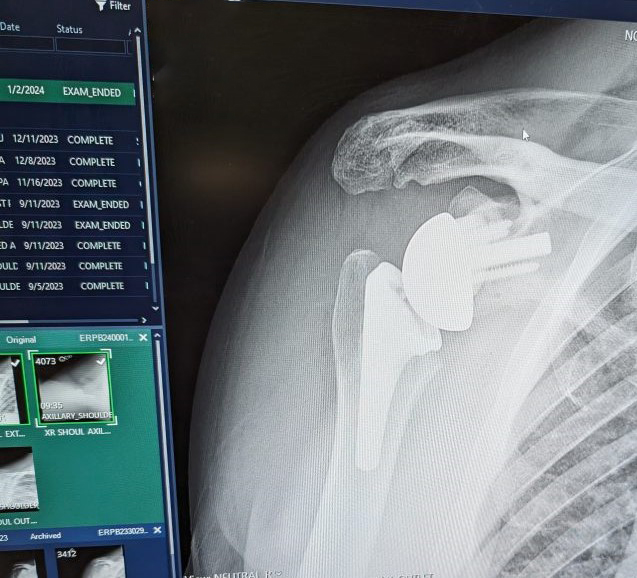
In an anatomic shoulder replacement surgery (also known as "traditional shoulder replacement"), the damaged humeral head (the ball of the shoulder joint) is replaced with a metal ball, and the glenoid cavity (the joint socket) is replaced with a smooth plastic socket, similar to that in a total hip replacement.
More recently, a different type of surgery called reverse shoulder replacement was introduced to benefit patients who had a current or prior rotator cuff tear. This metal-on-plastic implant design is used in virtually all shoulder replacement.
In some patients, such as those with severe shoulder fractures of the humeral head, a partial shoulder replacement (also known as a "hemiarthroplasty") may be recommended. This technique replaces the ball component only.

X-ray of a modern anatomic shoulder implant with a shallow anchor in the upper humerus rather than the long stem used in older implants.
Anesthesia in shoulder replacement
During a total shoulder replacement, the patient may have either regional anesthesia with interscalene block or general anesthesia – or both. During the operation, the patient will be positioned sitting upright and partially or completely sedated.
Surgical steps of an anatomic shoulder replacement
A traditional, anatomic shoulder replacement surgery is composed of the following six basic steps:
- The surgeon separates the deltoid and pectoral muscles to access the shoulder in a largely nerve-free area (to minimize nerve damage).
- The long head biceps tendon is commonly degenerated in an arthritis shoulder and repaired at the time of surgery.
- The shoulder is opened by releasing one of the front muscles of the rotator cuff, which covers the shoulder. This “opens the door” to allow the surgeon to view and manipulate the arthritic parts of the shoulder ball and socket.
- The arthritic sections of the joint are removed.
- The implant socket, ball and stem components are inserted. The incision of the rotator cuff tendon is repaired.
- The external (skin-level) incision is cleaned and stitched, and a bandage applied as a temporary covering.
Shoulder replacement surgery video
This animation of an anatomic shoulder replacement shows the implantation of a traditional, stemmed humeral prosthesis.
How long does a shoulder replacement implant last?
Prior evidence suggests that an anatomic shoulder replacement can be expected to last approximately 15 to 20 years. However, there are numerous patient-specific variables that may contribute to the durability of a shoulder replacement, including patient age, overall activity level, functional status, and rotator cuff integrity. Additionally, prior data is based upon shoulder replacement implants that existed 15 or more years ago. Numerous technological advancements may increase the longevity of modern shoulder replacement implants.2
Types of shoulder replacement implants
All shoulder replacement systems share the same basic components: a metal ball that rests against a plastic (polyethylene) socket. But their designs vary. HSS surgeons have led the design of both conventional and reverse shoulder replacement implants.
Anatomic shoulder replacements
The polyethylene socket in a traditional shoulder replacement is often cemented to the bone surrounding it, at least in part, so that fixation to the bone is immediate. Alternative designs have a small titanium post behind the socket to allow for bony incorporation as well.
The prosthetic ball has a stem or a small nucleus that is usually placed inside the humerus without the need for cement. In most cases, the design of the stem prosthesis promotes osseointegration, in which the patient's natural bone grows into the prosthetic material.
Reverse shoulder replacements
In a reverse total shoulder replacement, the components are still metal and plastic, but reversed: The metal ball is attached to the patient's existing socket, and a new plastic socket is attached to the patient's upper humerus, which formerly included the natural ball of the anatomic shoulder.
What are the risks and complications of a shoulder replacement?
Complications are rare in total shoulder replacement, but can include:
- instability (the ball slipping out of the socket)
- rotator cuff tear
- infection
- nerve damage
- glenoid loosening
- stiffness*
*An arthritic shoulder is often very tight prior to surgery. If, however, stiffness is still a problem in the shoulder after motion was restored during surgery, this may be the result of incomplete rehabilitation. Continuous physical therapy efforts are usually effective in restoring shoulder motion and strength.
Can you go home right after shoulder replacement surgery?
Due to advancements in surgical and anesthetic techniques, patients are increasingly undergoing shoulder replacement surgery as an ambulatory procedure in which they go home the day of surgery. Advantages of going home the day of surgery include a more comfortable recovery environment and reduced exposure to potential infection risk.
At HSS, patients are evaluated preoperatively by a medical physician to determine whether they may be candidates for having their procedure performed in an ambulatory setting.
What is the shoulder replacement recovery time?
It generally takes 12 weeks or more for patients to recover. It may also be several months before a person may do heavy labor or strenuous strength exercises.
On the day of surgery
The patient will wake up in the recovery room with the arm immobilized at the side in a removable canvass arm sling. People usually experience some temporary pain due to the surgery, but it is not the same type of pain they experienced due to their arthritis. Arthritic pain is largely absent from that point forward.
The weeks after surgery
The shoulder will be immobilized by a shoulder brace during the early rehabilitation phase to permit the tendons which have been repaired to heal. This sling is removable for showering and for rehabilitation exercises. Mobility improves throughout the period of physical therapy.
Timeline for complete shoulder replacement surgery recovery
Soon after surgery, the patient is permitted to use the hand and wrist. The usual timelines for complete recovery are as follows:
- Six weeks – This is generally a protection phase. Physical therapy will begin working on gentle range of motion, with very little active shoulder movement. Patients typically start coming out of the sling at 4 to 6 weeks.
- Three months – Most people are reasonably comfortable, have a range of motion about half of what is normal, and experience some weakness.
- Six months – Most people report minimal pain (although they may experience pain during certain weather conditions), and have motion and strength about two-thirds that of a normal level.
- One year – Approximately 95% of shoulder replacement patients have little to no pain. Likewise, the vast majority of patients are back to their activities of daily living and most recreational activities.
Returning to work after total shoulder replacement
The exact time when a person can return to work depends on the type of work and the postoperative progress. Typically:
- Two to three weeks – Return to desk work is possible.
- Six months or more of recovery is required for heavier physical labor.
The presurgical condition of the person's shoulder muscles and tendons play the largest role in the time frame of a patient’s recovery. If the muscles and tendons are in good shape prior to surgery, rehabilitation will be easier.
In all cases, proper and extensive postoperative rehabilitation are key factors in achieving the maximum benefit of shoulder replacement surgery.
Are there any permanent restrictions after shoulder replacement?
Many patients who undergo a shoulder replacement procedure return to high-level sporting and recreational activities, including golf, tennis, and swimming. Specific post-operative activity restrictions vary between surgeons.
Is shoulder replacement surgery worth it?
Ultimately, this is a highly individualized question that requires communication between the patient and their surgeon. The substantial improvements in pain and function and the growing incidence of shoulder replacements performed in the United States and across the world suggest that the procedure can provide a meaningful and lasting improvement in patients.11
Why should I come to HSS for shoulder replacement surgery?
The best outcomes are shown to be achieved by surgeons who perform a high volume of this procedure each year. HSS surgeons perform more total shoulder replacements than are done at any other hospital in New York State – historically more than twice the number of surgeries as the next highest-volume hospital.7 In a survey of people who had total shoulder replacement at HSS, 100% reported improvement within 12 months after their treatment.6 In addition, HSS has low complication rates for this surgery. One independent study demonstrated that the complication rate at HSS was more than 30% lower than the national average.3
Key takeaways
- Shoulder replacement is highly successful at relieving pain and restoring mobility in people with advanced shoulder arthritis or severe fractures. About 95% of patients report pain-free function one year after surgery.
- There are two main types of shoulder replacement: anatomic (traditional) and reverse shoulder replacement. The choice of which type is best for each patient depends largely on the condition of their rotator cuff.
- The surgery replaces damaged joint surfaces with a metal ball and plastic socket to restore the smooth movement that is lost in the bone-on-bone friction caused by arthritis.
- Recovery typically takes 6 to 12 months, with physical therapy beginning on the day after surgery. Most patients return to light activity by six weeks and full activity by eight or more weeks.
- Not everyone is a good candidate. People with non-disabling symptoms, major muscle loss, infections, or certain neurological diseases may be advised against having this surgery.
Explore Related Patient Stories
View All Patient Stories
Alan Shanker
Stamford, Connecticut
Shoulder Replacement Surgery

Cindi Klar
Bronxville, NY
Shoulder Replacement Surgery

Anush Djahanbani
Princeton, NJ
Shoulder Replacement Surgery

B. Vincent Rovito
Mahwah, NJ
Shoulder Replacement Surgery

Todd Rosen
Queens, NY
Shoulder Replacement Surgery

Richard Boukas
Kew Gardens Hills, NY
Shoulder Replacement Surgery
Paul LaBosco
Huntington, NY
Shoulder Replacement Surgery

James Wellington
Glen Head, NY
Shoulder Replacement Surgery

Jane Davidson
Lititz, PA
Shoulder Replacement Surgery

Leonard Hershman
Ossining, NY
Shoulder Replacement Surgery

Steve Oshry
Tarrytown, NY
Shoulder Replacement Surgery

Paul Shyposh
Westfield, NJ
Shoulder Replacement Surgery

Lee Yaccarino
Fort Lee, NJ
Shoulder Replacement Surgery

Larry Lomrantz
Towaco, NJ
Shoulder Replacement Surgery

Joseph Twardy
Annandale, NJ
Shoulder Replacement Surgery

George Tirri
Mahwah, NJ
Shoulder Replacement Surgery

Bianca Russo
New York, NY
Shoulder Replacement Surgery

Gloria Erol
Bronx, Colombia
Shoulder Replacement Surgery

Orsola Dennie-Kretzschmar
Matawan, NJ
Shoulder Replacement Surgery

Dennis Nitka
Red Bank, NJ
Shoulder Replacement Surgery
References
- Catalyst OrthoScience Inc.; Blaine T. Catalyst OrthoScience announces first series of procedures using world’s only fully convertible stemmed CSR TSA system featuring an ellipsoid humeral head [Internet]. Naples (FL): Catalyst OrthoScience; 2023 May 25 [cited 2025 Nov 13]. Available from: https://catalystortho.com/2023/05/25/press-release-catalyst-orthoscience-announces-first-series-of-procedures-using-worlds-only-fully-convertible-stemmed-csr-tsa-system-featuring-an-ellipsoid-humeral-head/
- Cirino CM, Peterson JR, Williams AB, Cecere RA, Finocchiaro A, Chabot PJ, Gulotta LV. Short-Term Outcomes of Bone Grafting in Conjunction with the Comprehensive Total Shoulder system with a convertible metal-backed glenoid. J Shoulder Elbow Surg. 2025 Aug 2:S1058-2746(25)00560-9. doi: 10.1016/j.jse.2025.06.015. Epub ahead of print. PMID: 40759289. https://pubmed.ncbi.nlm.nih.gov/40759289/
- FAIR Health claims data (analysis of), January 2023 – June 2024 [cited 2025 Aug 24]. Complication rates: HSS rate 2.56% vs. national rate of 3.66%, during the period from January 1, 2023, through June 30, 2024. FAIR Health is a nonprofit organization whose mission is to supply reliable information for all stakeholders to improve health care quality, access and affordability. FAIR Health is not responsible for the conduct of the research or for any of the opinions expressed in this article.
See: https://www.fairhealthconsumer.org/quality and https://www.fairhealth.org/who-we-serve/research. - Food and Drug Administration. Summary 510(k) – Comprehensive® Primary Shoulder Stems [Internet]. Rockville (MD): U.S. FDA; 2006 Mar 13 [cited 2025 Nov 13]. Available from: https://www.accessdata.fda.gov/cdrh_docs/pdf6/K060692.pdf [accessdata.fda.gov]
- Hospital for Special Surgery (HSS). HSS surgeon performs world’s first implant of a stemmed elliptical head prosthesis for anatomic shoulder replacement [Internet]. New York (NY): HSS; 2023 Jun 27 [cited 2025 Nov 13]. Available from: https://news.hss.edu/hss-surgeon-performs-worlds-first-implant-of-a-stemmed-elliptical-head-prosthesis-for-anatomic-shoulder-replacement/
- Hospital for Special Surgery (HSS). HSS Internal Data, 2020. 100% of respondents to surveys known as patient-reported outcome measures (PROMS) reported improvement within 12 months. The number of survey respondents was 34, which represented a 74% response rate.
- New York State Department of Health. Hospital Inpatient Discharges (SPARCS De-Identified): 2017 [Internet]. Albany (NY): New York State Department of Health; [cited 2025 Aug 24]. Available from: https://health.data.ny.gov/dataset/Hospital-Inpatient-Discharges-SPARCS-De-Identified/22g3-z7e7. Surgical volume: HSS performed 369 total shoulder replacements in 2017, which was 247% more than the next leading hospital.
- Ponce RB, Wrenn SP, White AE, Healy R, Brusalis CM, Cirino CM, Blaine TA, Taylor SA. Shoulder arthroplasty in the upper extremity weight-bearing patient: a systematic review of clinical outcomes and complications. J Shoulder Elbow Surg. 2025 Jan;34(1):e1-e14. doi: 10.1016/j.jse.2024.03.067. Epub 2024 May 27. PMID: 38810910. https://pubmed.ncbi.nlm.nih.gov/38810910/
- Varady NH, Wesorick BR, Garenani ML, Wimberly A, Taylor SA, Dines JS, Fu MC, Ode GE, Dines DM, Gulotta LV, Brusalis CM. What are we matching on and why? A systematic review of matched study designs in shoulder arthroplasty. J Shoulder Elbow Surg. 2025 Oct;34(10):e932-e943. doi: 10.1016/j.jse.2025.01.021. Epub 2025 Feb 17. PMID: 39971092. https://pubmed.ncbi.nlm.nih.gov/39971092/
- White AE, Omurzakov A, Omurzakov AM, Athanasian CE, Brusalis CM, Kew M, Fu MC, Gulotta LV, Taylor SA. Preoperative testosterone replacement therapy is associated with increased rates of periprosthetic joint infection, acute kidney injury, and emergency department utilization after total shoulder arthroplasty: a propensity-score matched analysis. J Shoulder Elbow Surg. 2025 Sep 1:S1058-2746(25)00622-6. doi: 10.1016/j.jse.2025.07.022. Epub ahead of print. PMID: 40902712. https://pubmed.ncbi.nlm.nih.gov/40902712/
- White AE, Pascual-Leone N, Finocchiaro A, Brusalis CM, Dines DM, Dines JS, Kontaxis A, Taylor SA, Gulotta LV, Fu MC. What activities do patients hope to perform following anatomic total shoulder arthroplasty but are unable to? Looking beyond patient-reported outcome measures. JSES Int. 2024 Sep 23;9(1):188-193. doi: 10.1016/j.jseint.2024.09.007. PMID: 39898198; PMCID: PMC11784514. https://pubmed.ncbi.nlm.nih.gov/39898198/